Stop Chatting, Start Scaling:
How AI Agents Transform Work
The real shift is not better answers in a chat window. It is a different way of organizing work.
Yuzheng Sun · Cornell PhD economist, founder of Superlinear Academy and AI Builders.
Amazon Economist in Perfect Order Experience from 2017 to 2019; later Meta, Tencent, and Statsig.
Why this talk starts with habits, not tools
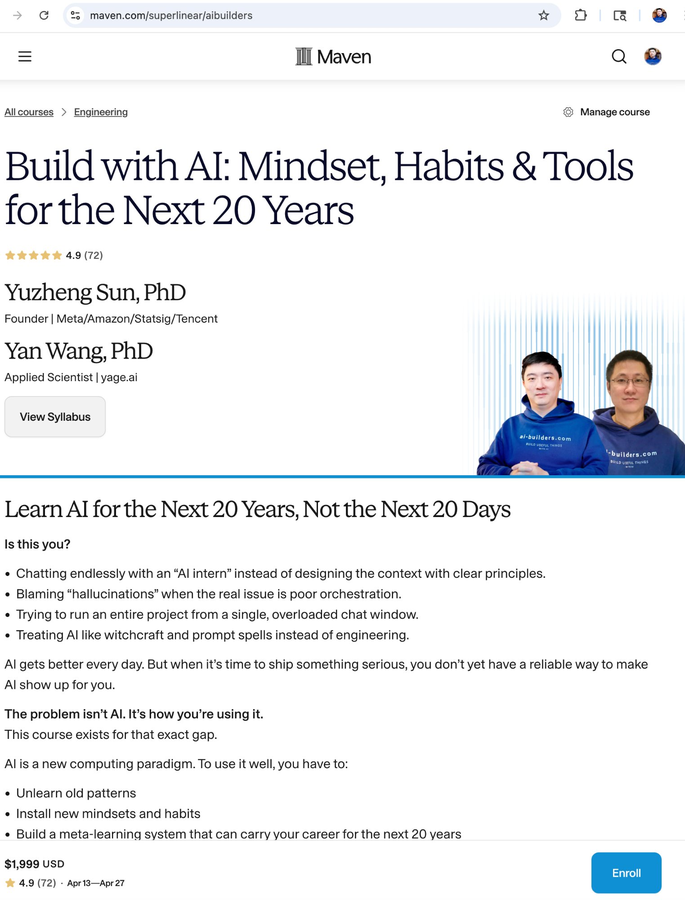
Outside this Amazon talk, I teach AI Builders. That is relevant because it gives me repeated exposure to where capable people get stuck in real projects.
The blocker is usually not model access, syntax, or the newest technical feature.
The hard part is getting into the gym: changing the default habit from asking AI for answers to building a working loop around AI.
My intention today: no fancy technology tour. Just a simple mindset and habit change that can profoundly change how you work with AI.
Three claims
Chat and agents are different work methods.
Not the same thing with different branding.
Agents matter because they compound.
Context, files, tests, and memory survive beyond a single session.
The aspiration is identity change.
From AI user to AI builder.
Some people get 30%. Few get 10x. (It is actually 1000x, I just do not want to sound dramatic.)
- Same models. Very different outcomes.
- The gap is not intelligence. It is the work method.
- Closed loops, richer context, and accumulated assets are what move the ceiling.
- human closes the loop
- hard to supply enough context
- output disappears after the task
- AI can run inside the loop
- can pull in the real working context
- leaves rules, files, and tests behind
AI is the electric motor story again
New tool
- drop AI into the old workflow
- keep everything else the same
Expected result
- faster local tasks
- incremental gain
Real result
- redesign work around what AI can own
- that is where step-change value comes from
Chat = swap in a new tool. Agents = redesign the line.
Chat gives advice.
Cursor and agents work inside the environment.
Why the chat window is a ceiling
Open loop vs. closed loop
- Chat: AI outputs, you run it, you carry errors back.
- Agent: AI can run, inspect, retry, and self-correct.
- Result: you stop being the human middleware.
Blind prompting vs. real context
- Chat: you must manually brief the entire situation.
- Agent: it can read docs, files, notes, and project artifacts.
- Result: quality is driven by context, not just model IQ.
Disposable answers vs. compounding systems
- Chat: each conversation starts close to zero.
- Agent: rules, tests, docs, and structure stay in the workflow.
- Result: every round makes the next round cheaper.
The demo is one policy change across a small but real system
- change oversized shipping from
2-dayto3-5 business days - keep a Prime exception for the top 20 metro areas
- update every customer-facing surface
- make the next policy change cheaper
- multiple files
- copy plus implementation
- tests and verification
- a second request that exposes whether value compounds
Demo repo: go.ai-builders.com/amazon
The hidden problem: one policy is scattered across the product
Duplicated business rule
The same oversized-shipping promise is hardcoded in checkout, order confirmation, and help center.
Same rule. Three places to forget.
Change without drift
Move to 3-5 business days while preserving the Prime metro exception.
Copy, logic, and tests must agree.
Make the next change cheaper
Create one shared policy source so future exceptions are smaller changes, not another file hunt.
Advice, then manual coordination.Suggest likely edits. You still copy changes, run tests, and catch missed surfaces.
Inspect, change, verify, and leave structure.Read the repo, centralize the policy, update surfaces, run tests, and repair failures.
The difference: chat helps patch instances; an agent can improve the system that produces those instances.
Get the demo files on your laptop
- open
go.ai-builders.com/amazon - GitHub: Code -> Download ZIP
- unzip on Desktop
- open
oversized-shipping-demo/starter - read
docs/change-request.md
checkout.htmlorder-confirmation.htmlhelp-center.htmldocs/shipping-policy.md
No setup pressure. You can follow the idea by just reading the files. The goal is to notice how many places the same policy appears.
Now think like ChatGPT
cd ~/Desktopgit clone https://github.com/sunyuzheng/stop-chatting-start-scaling.gitcd stop-chatting-start-scaling/oversized-shipping-demo/starternpm test(optional baseline check)
- which files would you paste into chat?
- how would you find every duplicated policy?
- where should the shared policy source live?
- how would you verify the result?
Explore for a few minutes. npm test is not required; it only confirms the starting repo still has the old duplicated 2-day delivery policy. Then we will compare ChatGPT advice vs. Cursor execution.
The instruction I give the agent
Implement the policy change across the repo.
- update the oversized shipping promise to
3-5 business days - preserve the Prime exception for the top 20 metro areas
- remove scattered hardcoded copy
- create one shared policy source
- update tests, run them, and fix failures
Give advice, sample code, and likely edit locations.
Read the repo, apply the edits, run checks, and leave a cleaner architecture behind.
The first run created assets
Policy module
The business rule now lives in one place.
Shared customer copy
Checkout, email, and help center stay aligned.
Tests
The next change is now safer and cheaper.
The second request is the real demo
- expand the Prime metro exception from top 20 to top 40
- add a remote-state exception for Alaska and Hawaii
If the first run was only a patch, the second change is expensive again. If the first run created structure, the second change is cheap.
That is compounding.
From AI User to AI Builder
Calibration
Good judgment about what AI can and cannot do.
Usable output
AI work can enter the workflow directly.
Delegation
Complete tasks move to agentic loops.
Memory
Experience accumulates into reusable system behavior.
Thinking Partner
AI starts surfacing better options, tradeoffs, and blind spots.
If you want the full upgrade path, this is the course
- 2+ years of continuous iteration
- 12 live cohorts delivered
- 3,000+ learners validated
- 4.9/5 rating on Maven

Amazon code: use coupon amazon for $100 off.
Applies to: the AI Builders bundle.
Register: ai-builders.com
Format: practical, project-based, and built around durable methods, not prompt tricks.
Risk: 14-day refund.
What learners consistently say
All reviews are public and attributable on Maven. The strongest signal is not “nice content.” It is lasting behavior change.
A learner from Yipi Tech said the course helped him build a tool from scratch in an unfamiliar language and earn back roughly 2x the tuition.
Marvin, Developer, Yipi Tech
A Google UX leader said that even as a daily AI user, she still learned a deeper and more effective way to build with AI.
Clairy Cheung, UX Manager, Google
A Microsoft applied scientist said the biggest gain was a mindset shift: using AI to solve real problems became a habit, not an occasional experiment.
Tingting Wang, Applied Scientist, Microsoft
How the course teaches that progression
Calibration
Good judgment about what AI can and cannot do.
Usable output
AI work can enter the workflow directly.
Delegation
Complete tasks move to agentic loops.
Memory
Experience becomes reusable system behavior.
Thinking Partner
AI surfaces better options, tradeoffs, and blind spots.
Same path, now taught as a five-stage progression.
The methods behind each stage
- correct mental models
- signal / noise filtering
- real-work capability probing
- document-first standards
- curated context
- outcome-oriented specs
- task spectrum mapping
- comparative advantage focus
- agentic loops for full tasks
- personal context architecture
- template and skill library
- workflow migration, one at a time
- cross-domain leverage
- AI-native business design
- build real projects to expand confidence
These are methods, not prompts. Free project support and examples: superlinear.academy/c/share-your-projects-en/
Chat helps with tasks.
Agents change the operating model.
That is why agents can capture compounding value and chat alone cannot.
Deck and demo repo: go.ai-builders.com/amazon
Course details: ai-builders.com. Coupon amazon: $100 off the AI Builders bundle.
Free community support and project sharing: superlinear.academy/c/share-your-projects-en/